
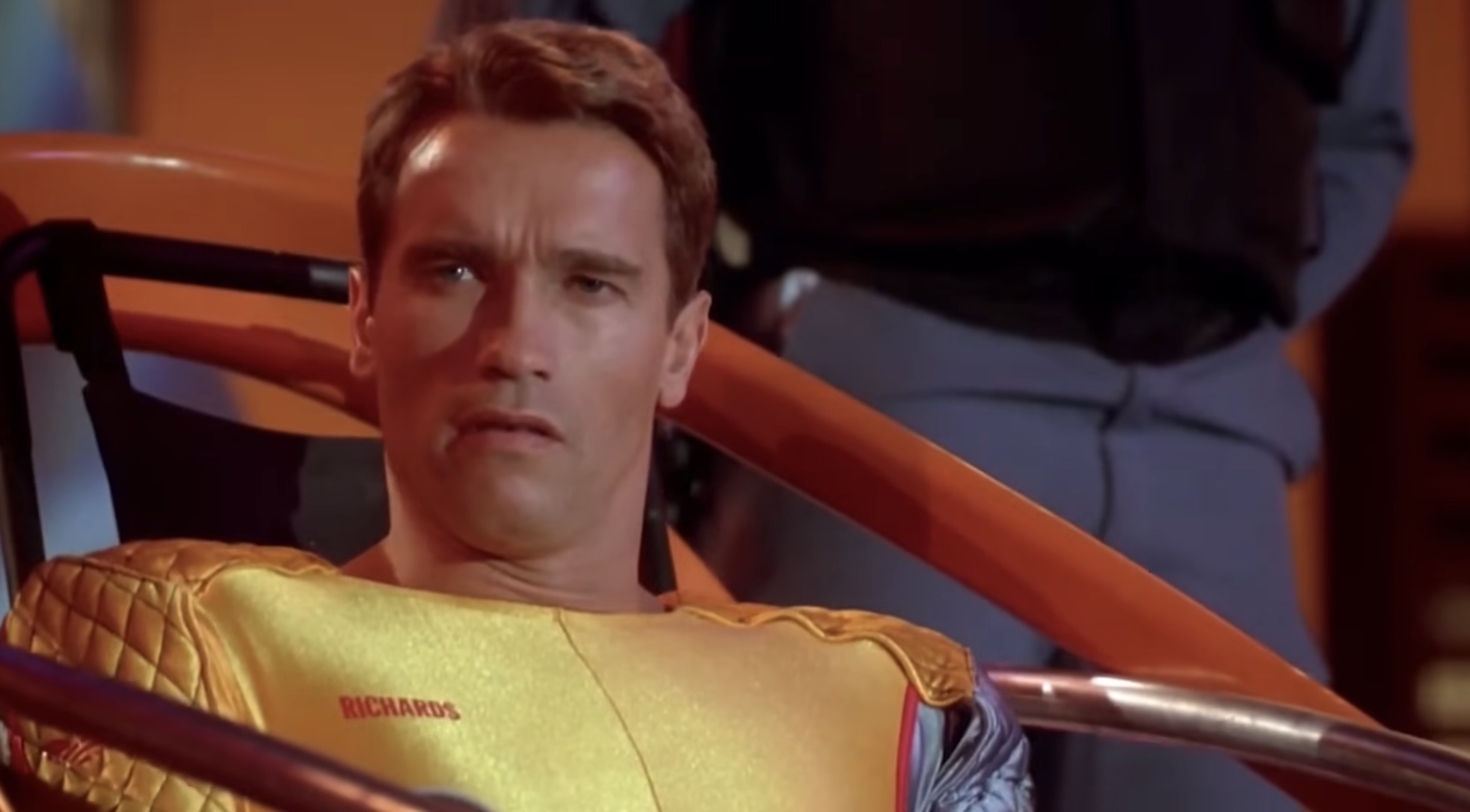
The original movie adaptation of Stephen King’s “The Running Man” was released in 1987. It wasn’t a huge box office or critical success. However, going on 20 years later and with the remake now in theaters, it felt like the best time for a rewatch.
- Directed by: Paul Michael Glaser
- Written by: Stephen King. Steven E. de Souza
- Starring: Arnold Schwarzenegger. Maria Conchita Alonso
Yaphet Kotto
The Plot
The Running Man, the movie, tells the story of a dystopia future where the totalitarian police state’s justice department works with an entertainment division. The public is subjected to nonstop propaganda and censorship. The story focuses on Ben Richards, a soldier falsely accused of massacring civilians in a food riot. After breaking out of prison and taking a justice department composer, Amber, hostage during his attempt to flee, Richards is recaptured and forced to take part in flashy, televised death game called “The Running Man”.
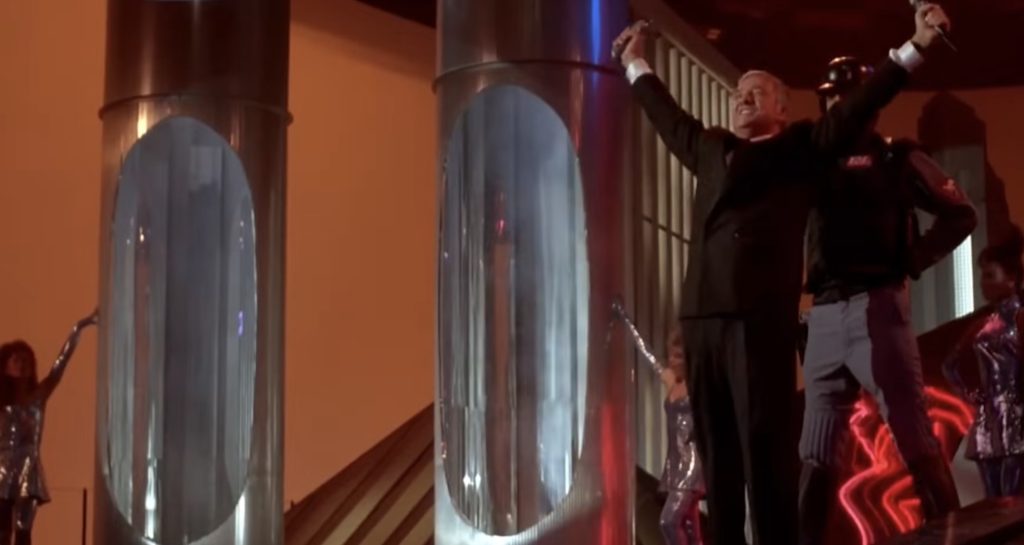
He’s aided by two revolutionaries, and eventually Amber, who are all forced to join him in the game. They end up working together to fight off the stalkers who are coming to kill them and try to end the games for good.
The Review
So, first things first: the original movie doesn’t have much in common with the book. That’s not really what where here to talk about though. The book is great, and you should read it.
I want to talk about the movie on its own merits. It may be hard to see them past the gold spandex jumpsuit and opera-singing killer, but they are there. I have a fondness for dystopian sci-fi thrillers, especially ones that lean towards dark comedy. Robocop is one of my all-time favorite movies.
Dystopian Worldbuilding
The Running Man is not Robocop, but it does tackle the intersection of government and media in some interesting ways. Putting aside the cheesy stalkers and their gimmicks, the way the show “The Running Man” is portrayed is, in short, fascinating. It’s one part “American Gladiators” with a little “Price is Right” thrown in. Outside the studio, people place bets on their favorite stalkers. The crowd cheers giddily for men who are about to kill prisoners of the state trying to win “fabulous prizes” like a jury trial, something we take for granted today.
The interesting part is how quickly the crowd turns on their beloved stalkers. After Ben kills SubZero and Buzzsaw, their bloodthirsty nature turns on the stalkers they once cheered for. After Ben won’t kill an incapacitated Dynamo—seriously, these names are killing me—they boo his mercy.
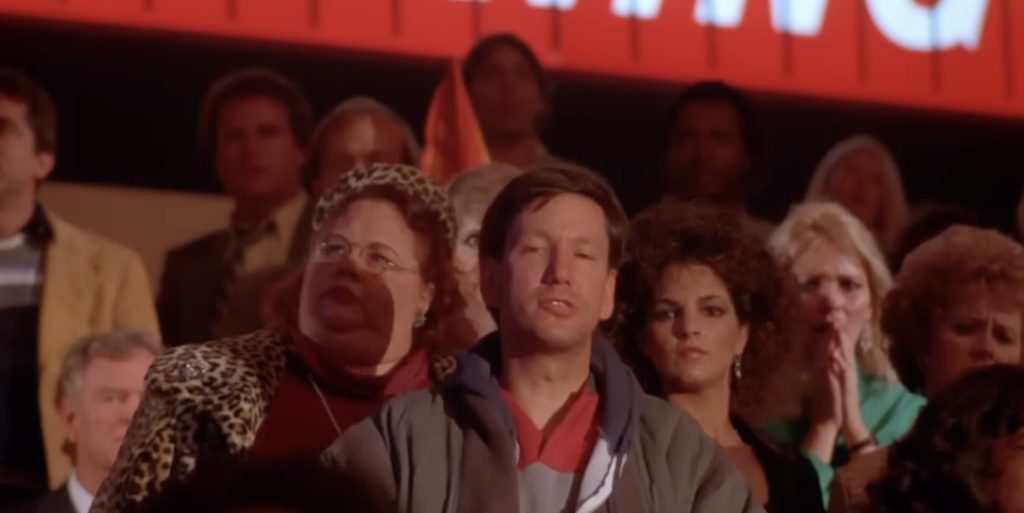
The Crowd is Fickle
Shortly after, a sweet old lady in the crowd picks Ben to make the next kill. When the host, Killian, tells her she has to pick a stalker, she refuses. The crowd starts to agree with her and outside, the betters place money on Ben. Killian starts to realize that things are getting out of hand.
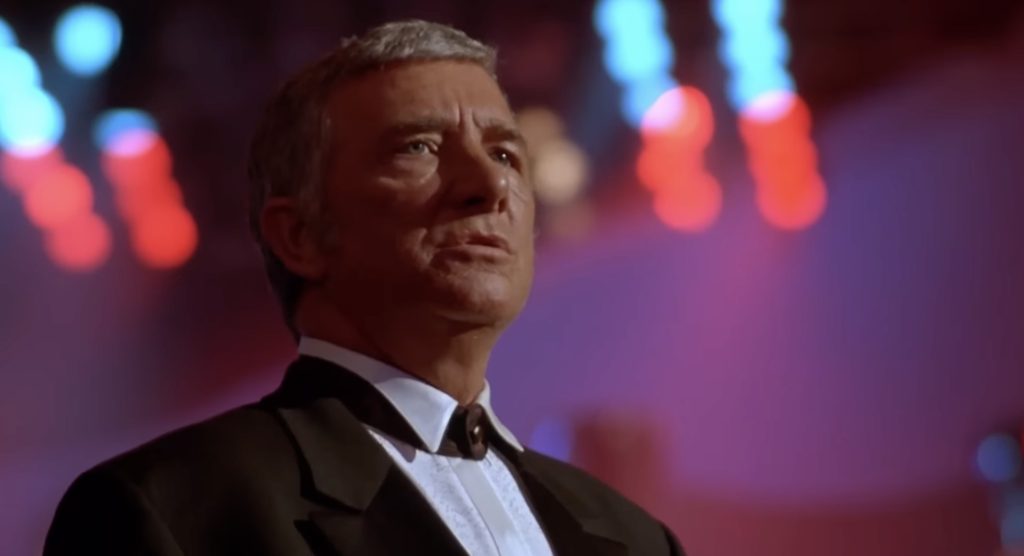
The thing is, the crowd doesn’t care about Ben’s politics, or him being right or wrong. In fact, Ben has no politics. He’s actively trying to avoid helping the resistance and is focused on just keeping himself out of trouble. It’s only when their goals align that he joins up. Remember, before the system turned on him, Ben was an active participant in it.
The crowd responds exactly the way they were trained. They’re going to cheer for whoever the TV tells them the winner is. Killian is smart enough to realize this and offers Ben a spot as a hunter. Since Ben hates him and the whole system for the framing and imprisoning thing, that doesn’t work out.
Not The Usual Hero
The Running Man is not a story of noble, principled men resisting a broken system. It also isn’t a story about a man who realizes the system he serves is broken and corrupt, then decides to fight back. This is a personal revenge story within the framework of a dystopian world. That makes for some wildly uneven, but interesting, viewing.
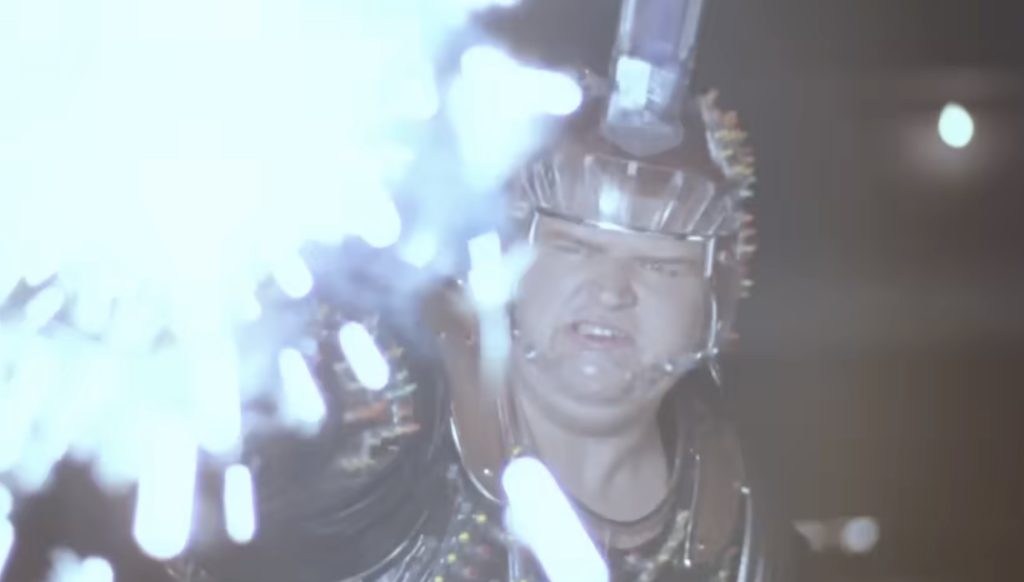
Seriously, The Running Man is like peak ‘80s Arnold, complete with cheesy one-liners and bad jokes. You’re not going to get an Oscar-worthy performance out of him, or the leading lady, here.
Media and Mayhem
I haven’t seen the remake yet. I will, I’ve just been busy doing stuff. It is interesting that two Stephen King stories about totalitarian governments imposing death games to pacify the populace, became movies this year. I think it’s probably time for us to take a good, hard look at our media habits, you know, as a culture.
The role of media and the intersection of news, movies, and entertainment as a catalyst for violence in movies, isn’t new or novel. We just talked about Scream, which handles these themes brilliantly, and Robocop. Much of fiction wants to address how much sensationalism and propaganda shapes who we are as a society.
The Running Man puts it front and center. Even more so in the book, where the stalkers are aided by the audience. It’s a very different game in the book. Again, please read it. They both reinforce the theme that people are a product of what they consume. They also reinforce that the only way to break the cycle is to walk away.
The Running Man is available on streaming, in theaters and at your local library.
Leave a Reply