

For those who only know Fujimoto though Chainsaw Man or Fire Punch, Look Back may seem at first glance a departure, but the characters and depth of emotion are instantly recognizable. Look Back is the story of Fujino, who loves to draw, growing up while she struggles with the challenges of life in a creative field. It’s also about what motivates people to create, and keep creating, in the face of all the hardships and pain that comes along with pursuing artistic careers.
- Written by Tatsuki Fujimoto
- Directed by: Kiyotaka Oshiyama
- Starring: Yuumi Kawai, Muzuki Yoshida
Characters Drive Conflict
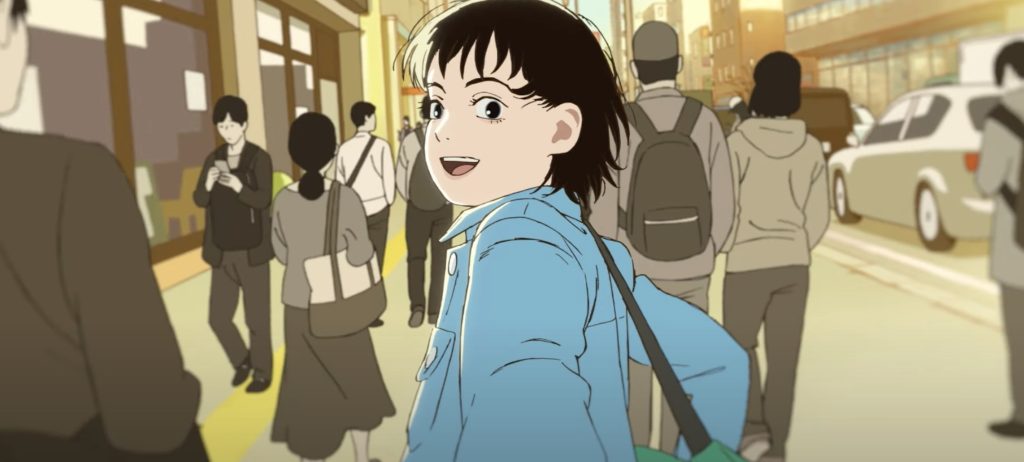
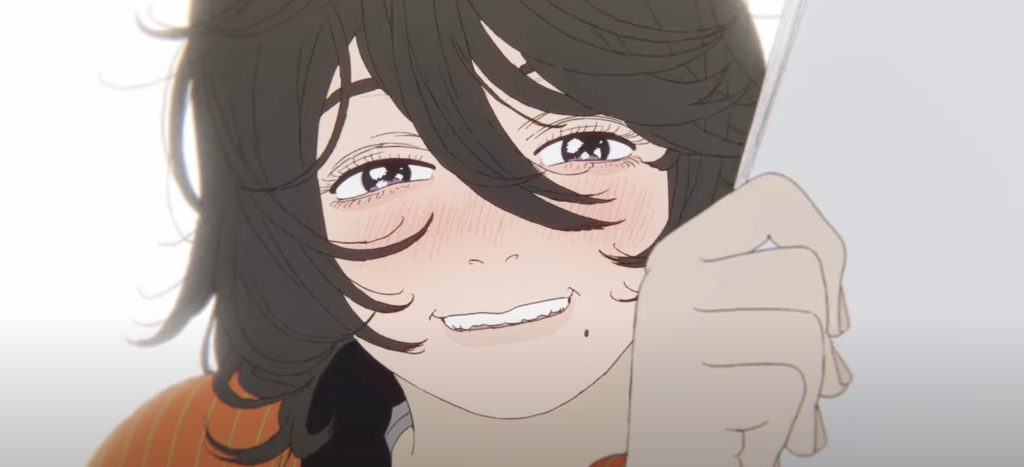
Strip away the violence and gore of Chainsaw Man, and you’ll find characters that have a lot in common with the leads in Look Back. Fujino is a stubborn and prideful young girl, having constructed her identity around her skill as a manga artist. She’s immature and over inflates her skill and accomplishments for praise, but only because of her insecurities. Fujino is easy to relate to, but difficult to like, at least in the beginning. Kyomoto, her classmate and friend, is less defined because we mostly see her through Fujino’s eyes. A shut-in with severe social anxiety, she found refuge in drawing elaborate detailed backgrounds, She spends her time carefully and thoughtfully rendering places she might never see from her bedroom. The theme of escapism through art will become familiar territory for Fujimoto in later works. I highly recommend Goodbye Eri for more on this.
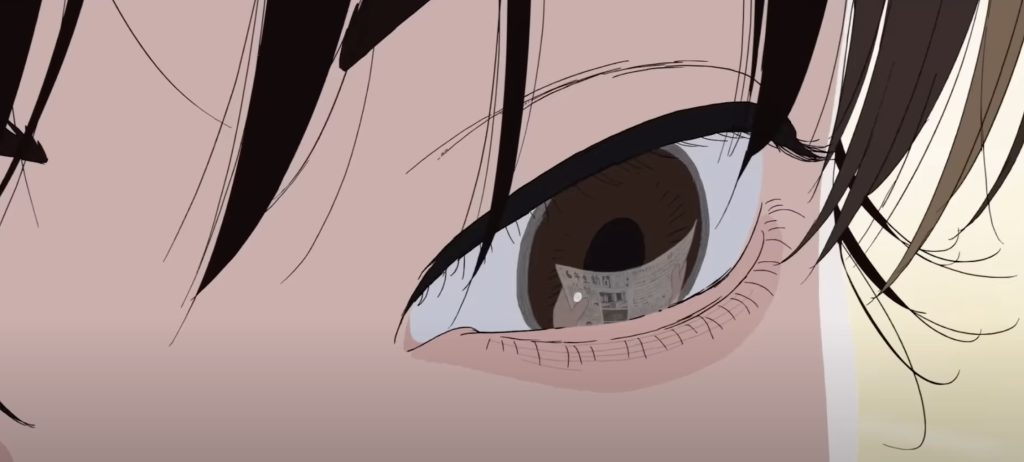
At just 60 minutes, Look Back is short and sweet. It delivers its point effectively with no padding, and plenty of beautiful animation. There is a fluid quality in Fujimoto’s art that has always been a large part of the appeal for me, and it is captured here perfectly.
Review and Recap – Spoilers Ahead
After introducing the audience to Fujino through her art, a four-panel strip in her middle school newspaper, and her classmate’s reaction to it: glowing praise. Fujino is asked if she could give up some space in the paper to a classmate who is working from home. Fujino is dismissive of their efforts and expresses fake concern that the newcomer will look bad next to her.
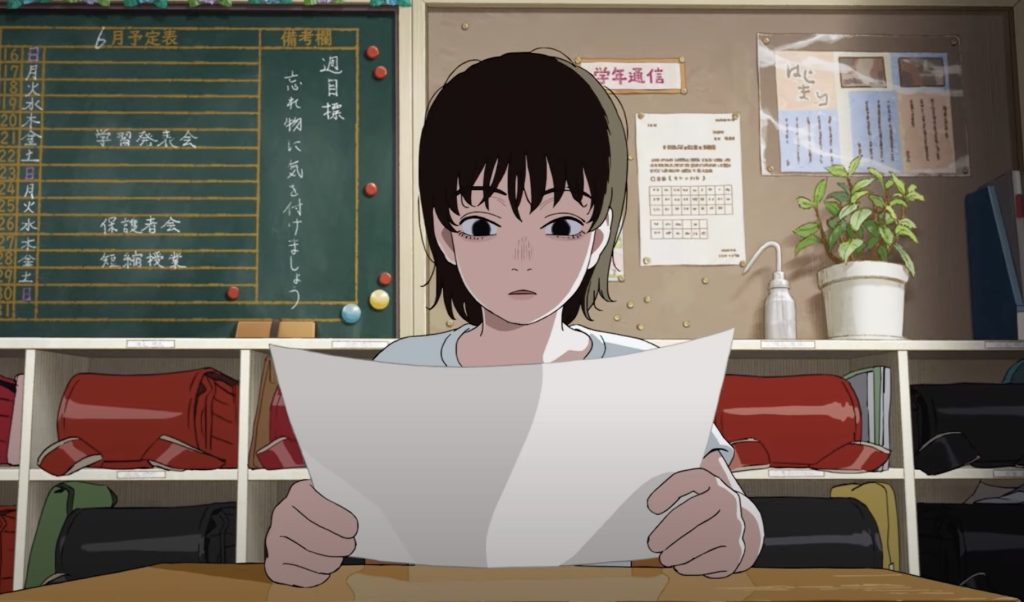
When the two strips are published side by side, Fujino’s art looks crude in comparison to Kyomoto’s detailed backgrounds. Her classmates instantly take notice, praising the new art and irritating Fujino. From here, Fujino puts everything into improving, buying books and filling up sketchbooks practicing.
What She Gives Up for Art
She spends a year on this; Look Back is not afraid to show the length of time it takes to build skills, and what you give up in the pursuit of excellence. She ignores family gatherings, friends, and other activities, just to get better. But she can’t; Kyomoto’s backgrounds are still better than hers, so halfway through 6th grade, she quits drawing. She throws out her pile of sketch books, joins karate, hangs out with friends and family, and seems happy.
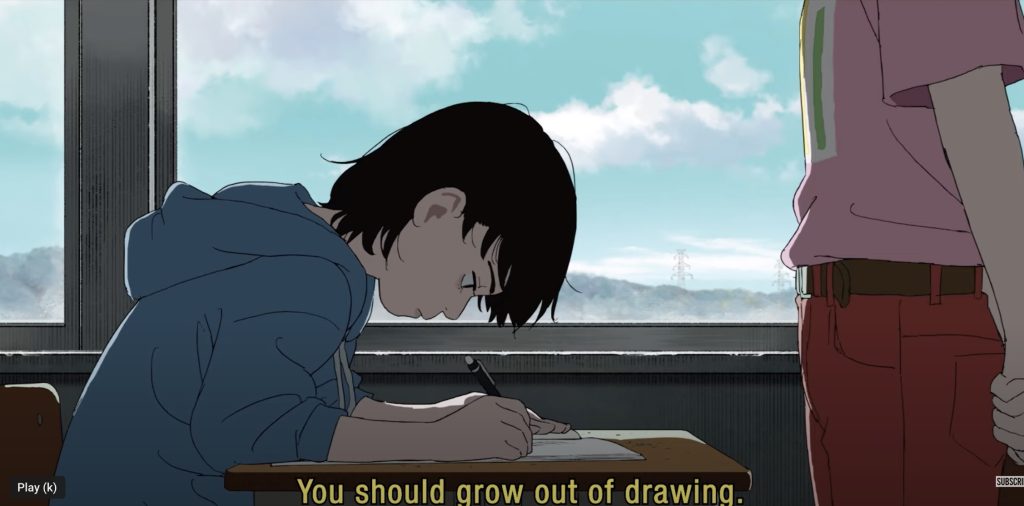
Until she graduates. Her teacher asks her to drop off Kyomoto’s diploma at her house. Finding the front door unlocked, her curiosity gets the better of her and she lets herself in. Who does that?
Meet Cute
Once inside, she sees the amount of sketch books Kyomoto has filled up. It’s easily five times the amount Fujino did. She draws a comic where Kyomoto has been shut in so long, she’s died, but before she can trash it, it slides under the door to her room.
It’s enough to get Kyomoto out of her house; it turns out she’s a fan of Fujino and wants her autograph. She also wants to know why she quit drawing. Fujino signs her jacket and, unable to admit that she quit because of her jealousy, lies about working on a manga for a competition. After that Fujino races home, ready to start drawing again.
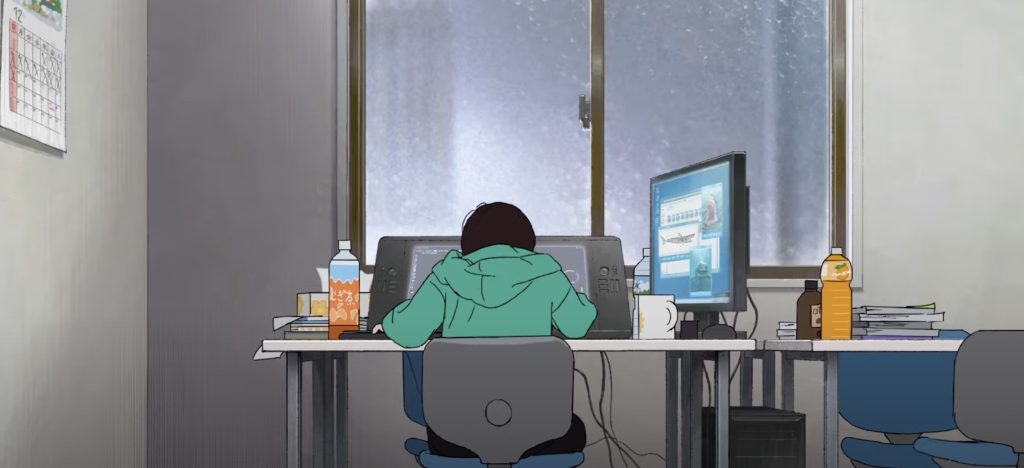
The two begin working together and achieve acclaim for their one-shot, as Kyomoto begins to overcome her social anxiety.
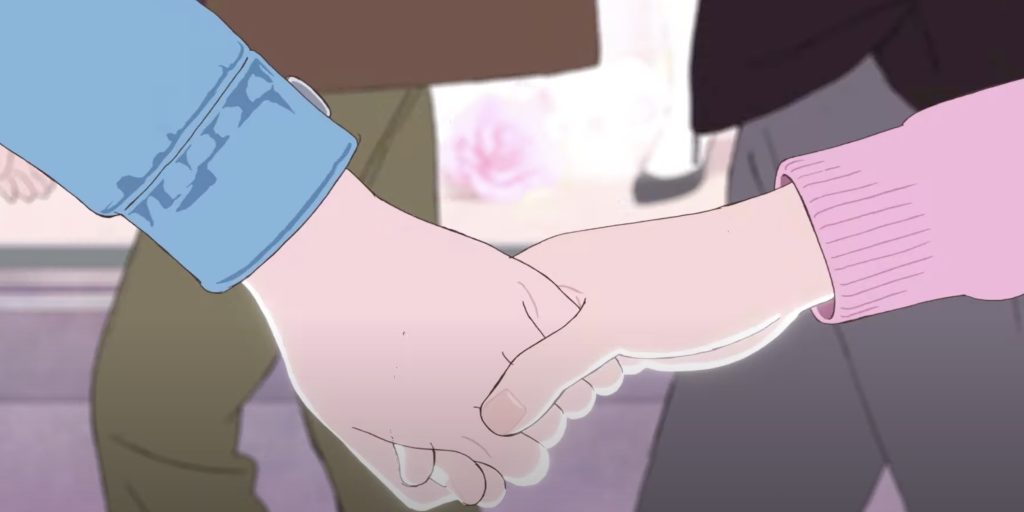
Growing Up
Watching the two girls grow closer while they get inspired by the life around them and create new manga, is both beautiful and heartbreaking. They’re growing up, drawing and collaborating, but also growing apart; the growing distance between their paths illustrated by Kyomoto’s hand slipping out of Fujino’s as they run towards the future.
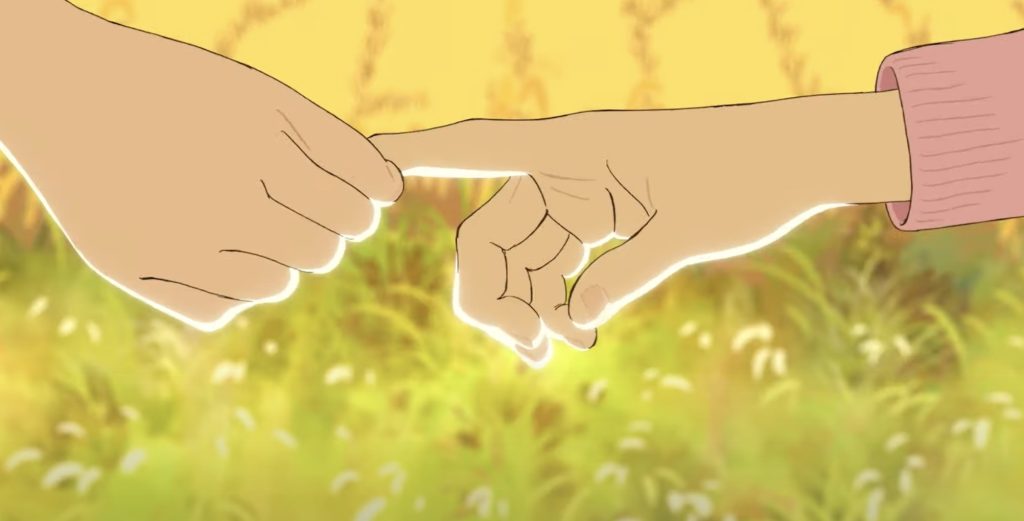
As they reach high school, they get an offer to be serialized but Kyomoto wants to go to art school and learn to be independent. Fujino reacts poorly and they fight. Fujino throws everything into her manga Shark Kick, which takes off and gets an anime adaptation. But something is missing in her life.
Life Happens
While she is working on her manga, she learns Kyomoto has been killed in an attack at the Art University. Fujino is devastated and places the book on hiatus.
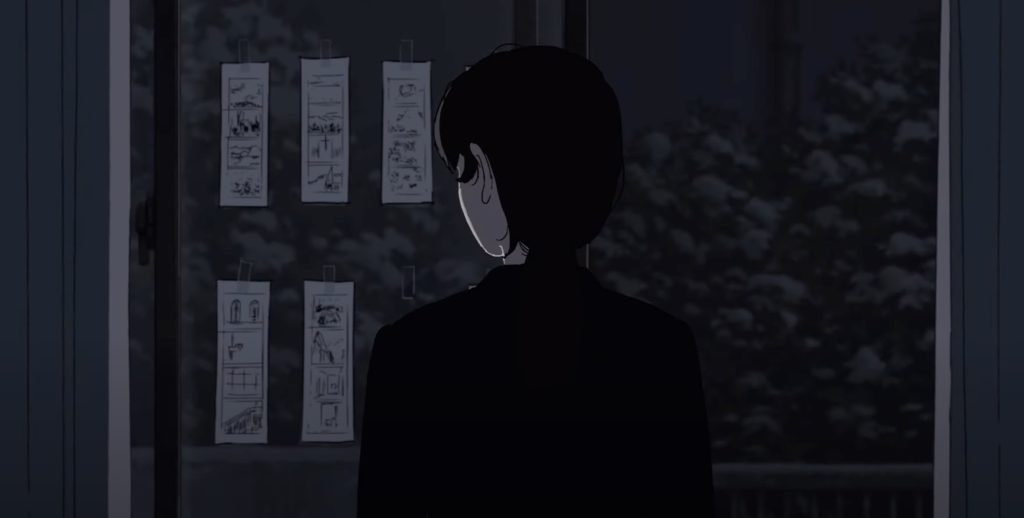
Fujino visits Kyomoto’s room and discovers that she kept the four-panel manga that she drew for her. She blames herself for inspiring Kyomoto to be a better artist, leading her to art school.
She tears the comic into scraps; one scrap travels back in time where Kyomoto finds it. But it’s just the first panel; reading “Don’t come out”, she never leaves her room. However, her path is still the same, she leaves her room eventually falls in love with art and goes to art school.
This time, before she can be killed, Fujino, who practices karate, intervenes. In this timeline, the two reconnect. Fujino tells her she is drawing again, and asks Kyomoto to be her assistant. Kyomoto runs home and, inspired to be reunited with her childhood idol, draws a comic
Looking Back
As Kyomoto draws a four-panel manga about Fujino saving her called “Look Back”, wind blows it back under the door where Fujino, in the real timeline, is sitting. Fujino finds it and finally enters Kyomoto’s room. As she does she thinks about how much she has suffered in her pursuit of creating manga.
But standing in Kyomoto’s room, she sees the jacket she signed for her when they first met, and copies of her manga Shark Kick. Kyomoto never stopped being her number one fan.
Even though she can’t change the past, Fujino can change the way she sees it, and the way she views her art, and its impact on her life. Especially at the end, when she can finally put her relationship with Kyomoto into perspective and move forward without regrets.
Fujino returns to work, taping the four-panel comic above her desk so she can keep Kyomoto nearby to continue to inspire her.
A Bittersweet Life
Creation is hard, and at times, unrewarding. Choosing to pursue a life in art, and I’m including all kinds of artistic endeavors here, means setting yourself up for rejection, self-doubt and an endless treadmill of improvement. But that’s not unique to art; you can experience that as a programmer or doctor.
Art does have the extra benefit of having people question its overall value to society. So, while you are putting your blood, sweat, and tears into your masterpiece, when you’re done, you can have total strangers ask, “why would anyone want this?”. I think one of the questions that keeps artists up at night when things are particularly difficult, is “why am I doing this to myself”. Look Back wants to answer that, especially in light of some of the horrific events that happen in the anime and manga industries.
Treatment of Artists
It should not be a secret that the anime industry underpays and overworks its animators. According to a survey of animators, the median hours worked in a month is 225, the average is 219, and the maximum is 336. Now the average and median don’t sound that bad when broken up by day, although I’m side-eying that max. Where things get really sketchy is the average pay: 1111 yen per hour; that’s $7.34 currently.
What about manga artists? The struggle to hit aggressive deadlines is an ongoing problem and can have a serious negative impact on the health of mangaka. There is a reason that death by overwork is a trope in anime and manga; it’s a real condition in Japan. Now, artists aren’t employees in the same way office workers are, so their working conditions are different. But freelancers don’t deserve fewer protections from abusive work environments, unreasonable conditions, or hostile coworkers or editors.
Or the abusive public. The attack on the art school in Look Back is carried out by someone who believes his art was ripped off. In 2019, Kyoto Animation was attacked by an arsonist who believed they had plagiarized his art. His claims were investigated and found to have no merit. Thirty-six people died in the attack. I know this is a heavy topic for this review, but the inclusion of the attacker’s motivation as “plagiarism” is not a coincidence. It’s a reminder.
Final Thoughts
Look Back takes a broad look at some of the negatives of the process of creation and asks, is it “worth it to keep going”. Not only that, it does it several times throughout Fujino’s life, and each time, she returns to drawing. Art is painful, but it’s also healing.
If you are looking for a thoughtful exploration of art and its impact on our lives, check this out. If you are in the mood for something a little more Chainsaw-y this is not the Fujimoto story for you. But it’s your loss.
What I Liked:
What I Didn’t
- Beautiful animation
- Heartbreaking voice acting
- Impactful story
- Now I want a Goodbye Eri movie and I don’t have one.
Look Back is available to stream on Amazon.
Check out my other anime reviews:
Leave a Reply