
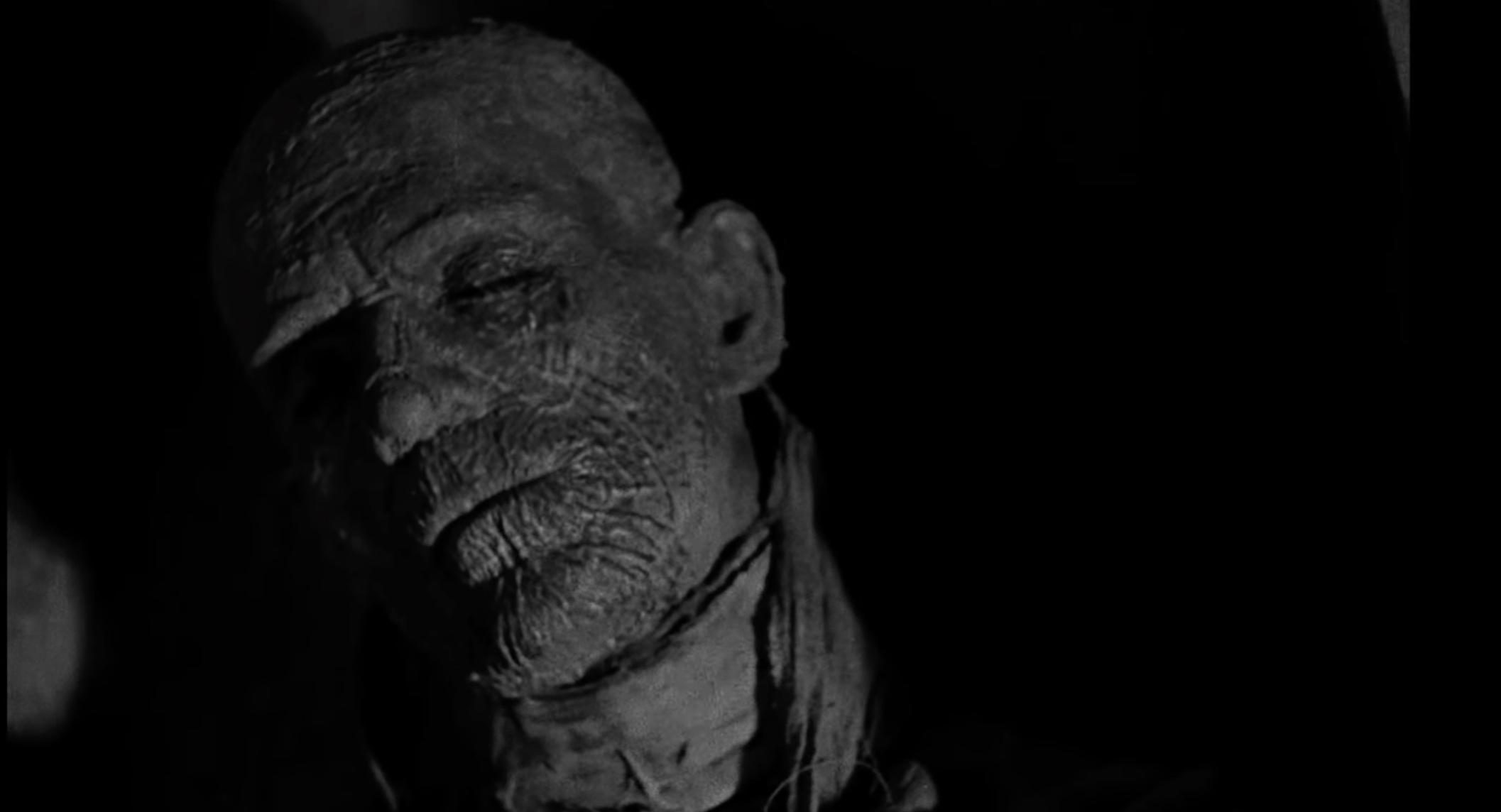
It would be impossible to look at any of the Mummy movies without first addressing the glaring racism and imperialism present, since they start with the premise that Ancient Egyptian artifacts are better in the hands of white man. Of course, the white man suffers greatly for this, but the movie presents this not as justice, but horrific.
1932 The Mummy
- Directed By Karl Freund
- Written By: Nina Wilcox Putnam. Richard Schayer. John L. Balderston
- Starring: Boris Karloff. Zita Johann. David Manners
The Problems With The Mummy
This is largely because we are looking back into an era of archeological entitlement. Other countries’ histories, especially Egypt’s at the time, were seen as available for the taking by Western historians. The discovery of King Tutankhamun’s tomb in 1922 fueled this drive. As a result, today there continues to be ongoing legal battles and negotiations. Countries fight to have their historical treasures returned from museums and private collectors that obtained them unlawfully.

This is not to defend the behavior of the West. I’m not saying they didn’t know better, just that they didn’t care. And that attitude permeated the fiction of the time, resulting in The Mummy, a story about archeologists who took something that didn’t belong to them and paid for it, although perhaps not enough for my taste.
Time Was Not On Our Side
There is a lot that would not pass current sensibilities with the original version of The Mummy. However, the original may actually be less racist than the remake. In the end, neither version starts with the premise that Egypt has the right to its own culture, but only the 1999, Brendan Fraser version plays its foreign characters for laughs.
The 1999 version has some additional issues not present in the original. It leans more heavily into the “white savior” trope, so much so that it renders the native Egyptians, with sacred duty of protecting the grave of the Mummy for 3000 years, useless. It’s really bad once you notice it. What a waste of Oded Fehr. Subsequent remakes and sequels have tried to address these issues in various ways. It does seem to be a case of the more that filmmakers try to fix things, the worse it becomes. Adding the reincarnation plotline to the sequel doesn’t do much to detract from the colonizing. Instead, it gives a British woman a divine right to plunder.
Ghoul’s Note
Full disclosure time: I was professionally tangentially associated with The Mummy Returns and have nothing but positive things to say about the people involved and the experience I had. While the end result may have been deeply flawed and culturally questionable, at least no one was an ass.
I’m not going to talk about the Tom Cruise Mummy movie. That would require rewatching it, and I quite frankly do not want to.
Can You Enjoy The Mummy Knowing the Issues it Has?
Every movie has issues. I don’t bring up the complicated historical context to disparage the film, but to highlight the importance of the greater context of the world when movies are made. And to once again discuss the need to separate out the intent of the creator from the end result.
Could Someone Make a Non-Offensive Mummy?
The biggest issue with The Mummy is actually its dated depiction of race and ethnicity. It’s pretty painful to watch. The character of “The Nubian” is one of the worst parts. It’s a character without a name, in blackface, who only exists to be a servant and then mind-controlled. It’s not a good look.
Much of the over-the-top portrayals were due to the cultural obsession with Egypt and Orientalism at the time. In the current climate, it wouldn’t be necessary for marketing.
If one could manage to jettison the questionable characters, the plot would be salvageable. Although there are characters that question the supernatural happenings, in the end they rely on faith to save them, not science.

About the Plot
So, what kind of story can we tell with these basic plot elements? Every “mummy” story so far has made the assumption that the grave robbers, I mean archeologists, have to be The Good Guys. But what if this was not the case? Switching the dynamic clears up a few major issues. Now you have an ancient guardian defending its home, perhaps in horrific ways.
Finding the Horror
Now this doesn’t address the truly frightening aspect of The Mummy, the part most often ignored. Helen is losing herself to her past life. She is trapped and losing control, also in part because Imhotep can hypnotize people.

There is a lot here about bad relationships and men who feel entitled to more of women then they can give. This should be talked about more in regard to The Mummy, because in the end, it’s Helen / Anck-es-en-Amon, who saves herself by relying on her faith to Isis.

So, while much of the focus is on the curse, it’s the “love” story that drives the plot and character motives. But what if we just took the possession angle? Since we’re using our mummy to punish the guilty, what if we had the curse desiccate our grave robbers, turning them into mummies, effectively hollowing them out, physically and mentally? Maybe it gives the whole thing a nice, “replace what you stole” symmetry.
There is a new version due to be released soon. There’s nothing in the trailer that screams ‘this is culturally offensive”. But I’m a little nervous about another Wolf Man situation.
Final Thoughts
At the end of the day, The Mummy is a bit of a hard sell. It’s dependent on an outdated profession and culturally irrelevant or offensive depictions. It was also based on our lack of understanding of ancient practices, much of which we have gained a deeper understanding of. Fear is rooted in the unknown. We need something new to be afraid of.
The Mummy is available on streaming.
Leave a Reply